
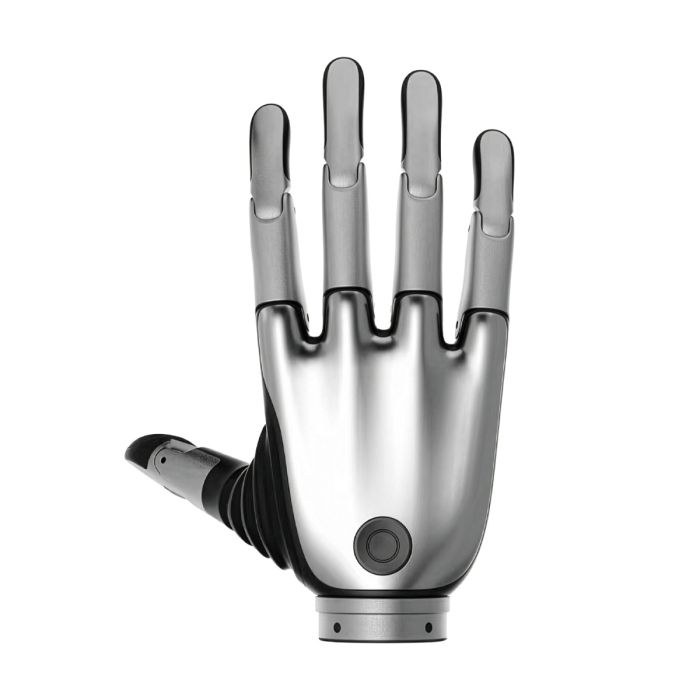
BrainCo Revo 2 Basic Right Dexterous Bionic Hand (XRR)
In stock
- BRAND:
- BRAINCO
- MODEL:
- REVO 2 BASIC
- PART #:
- XRL/XRR
- ORIGIN:
- China
- Warranty:
- 12 MONTHS
- AVAILABILITY:
- SUBJECT TO AVAILABILITY
- SKU:
- BrainCo-Revo-2-Basic
BrainCo Revo 2 Basic Right Dexterous Bionic Hand (XRR)
Handedness is easy to overlook until a humanoid or a dual-arm cell is actually assembled: a right wrist needs a right hand, and the two sides cannot simply be swapped. The BrainCo Revo 2 Basic Right Dexterous Bionic Hand (XRR) is the right-hand unit of the Basic configuration, described by its source as a bionic dexterous hand for robot integration and research. This article sets out what the published sources confirm about it, and says plainly where they are silent.
The product is available through this page, by quotation.
Background
The maker and the Revo 2 range
BrainCo is the brand behind the Revo line of dexterous hands. The Revo 2 is offered in three named configurations: Basic, Pro and Touch. Each is sold as a left-hand and a right-hand unit, and the sources identify them by version codes. The Basic configuration carries the codes XRL for the left hand and XRR for the right hand. The Pro configuration is coded XEL and XER, and the Touch configuration XTL and XTR.
The research sheet for this product does not carry a company history, so none is given here. What it does establish is the structure of the range, and that structure is useful to a buyer. The code on this page, XRR, tells you at once that you are looking at the Basic configuration and at the right hand. If your project needs the opposite side, the BrainCo Revo 2 Basic Left Dexterous Bionic Hand (XRL) is the matching unit.
Where the Basic configuration sits
A dexterous hand is a different kind of component from a parallel-jaw gripper. It is intended for work in which the shape of the object, rather than the shape of the tool, sets the terms: handles, latches, containers, irregular parts. Researchers use such hands to study grasping and in-hand manipulation, and integrators fit them to humanoid platforms and robot arms.
Within the Revo 2 family, the Basic configuration is the starting point of the naming scheme, with Pro and Touch as the other two named configurations. The sources available to us list the version names and codes only; they do not tabulate what separates one configuration from another. We therefore make no claim here about the advantages of one over another, and recommend that this be confirmed at quotation. The wider family can be browsed under BrainCo Revo 2.
Technical Specifications
| Specification | Value |
|---|---|
| Product type | Bionic dexterous hand for robot integration and research |
| Version | Basic |
| Version code | XRR (right hand); the Basic codes are XRL/XRR |
| Degrees of freedom | 11 (6 active) |
| Communication interface connector | BM05B-PASS-TFT(LF)(SN), located under the wrist |
| Default device ID | 127 for the right hand (126 for the left hand) |
| IP rating | Not published |
| Dimensions with wrist | Not published |
| Flexion/extension lifespan | Not published |
| Battery | Not published |
Specifications as published; each figure is reported from a single source and is to be confirmed against the datasheet at quotation. For the four items listed as not published, the manufacturer has not released a figure in the sources we hold, and the answer is confirmed at quotation.
What does 11 degrees of freedom with 6 active joints mean?
The published specification gives the hand 11 degrees of freedom, of which 6 are active. The distinction matters to anyone planning control software. An active degree of freedom is one the hand drives directly; the remaining ones are, as a general rule in hands of this type, coupled to the driven motion through the mechanism rather than commanded independently. The source sheet does not explain how the coupling is arranged on this hand, so we do not describe the mechanism, and we advise that the kinematic detail be requested if your controller design depends on it.
In practical terms, a team should expect to command a small number of active joints and to rely on the hand's structure for the finger motion that follows. For many grasping and pick-and-place studies that is a convenient arrangement, because the control problem stays tractable while the hand still presents five fingers to the object.
How is the hand connected and addressed?
The communication interface is located under the wrist, and the connector model is BM05B-PASS-TFT(LF)(SN), as reported by the source. Knowing the connector in advance helps with harness planning: it allows the mating cable to be specified before the hardware arrives, and it indicates where the cable will leave the wrist.
The device ID is the second practical detail. The published default for the right hand is 127, and for the left hand 126. This matters in a two-hand installation, because the two hands arrive with different default addresses and can in principle be told apart on a shared bus without prior reconfiguration. As with every figure on this page, it is stated per the published specification and should be checked at quotation, particularly if your integration changes the default.
The sources we hold do not set out the wiring pin-out, the supply requirements or the protocol details in the form we can reproduce, so none of these is given here. Please request them with the quotation.
Who is the BrainCo Revo 2 Basic Right Hand (XRR) for?
Research laboratories and university groups are the clearest audience, since the product is described as being for integration and research. A group studying grasp planning, teleoperation or learning-based manipulation needs a physical five-finger hand on the right side of a platform, and a configuration with a published degree-of-freedom count and a documented connector suits that purpose.
Robot integrators and humanoid developers form the second group. They need a hand that can be fitted to a right arm, addressed on a communication bus, and replaced or duplicated with a left counterpart. The separate default IDs and the paired XRL and XRR codes serve exactly that case.
Buyers who require a particular configuration should consider the neighbouring versions. The Pro configuration is available in a right-hand form as the BrainCo Revo 2 Pro Dexterous Right Hand (XER), and the Touch configuration as the Brainco Revo 2 Touch Biomimetic Dexterous Right Hand (XTR). Since the sources do not detail what each adds, we suggest asking for the comparison at quotation before choosing. Buyers looking at the wider selection can also see Hands.
Those who need only a simple holding function, with no interest in finger-level motion, may find a hand of this kind more than the task calls for. A dexterous hand earns its place when the objects vary.
What is the BrainCo Revo 2 Basic Right Hand (XRR) used for?
- Manipulation research: studying grasping, regrasping and in-hand motion with a physical five-finger right hand.
- Humanoid robot development: fitting a right-side hand to a humanoid arm that must work with everyday objects.
- Robot arm upgrades: replacing a simple gripper on a research arm where varied objects are handled.
- Teleoperation experiments: mapping an operator's hand motion onto a robot hand for remote tasks.
- Teaching and demonstration: showing students how a multi-joint hand is addressed, wired and controlled.
- Dual-hand cells: pairing with the left-hand unit, using the separate default IDs of 126 and 127, for two-handed tasks.
Pricing and Availability
No price is printed on this page. Quotation is the way to proceed: tell us the quantity, the platform the hand is to be fitted to and the questions you need answered, and a quotation will be prepared. Delivery, customs and support are arranged together with the quotation. Everything you need to begin an enquiry for the XRR is available on this page.
Frequently Asked Questions
Is this the left hand or the right hand?
It is the right hand, identified by the version code XRR. The left-hand unit of the same Basic configuration carries the code XRL.
How many degrees of freedom does the hand have?
The published specification gives 11 degrees of freedom, of which 6 are active. This is reported from a single source and is to be confirmed against the datasheet at quotation.
Where is the communication interface?
It is located under the wrist, and the connector model is reported as BM05B-PASS-TFT(LF)(SN). Please confirm the mating details at quotation.
What is the default device ID?
The reported default ID is 127 for the right hand and 126 for the left hand. A buyer who needs a different address should confirm the procedure with the quotation.
Is an IP rating, battery or lifespan figure available?
The manufacturer has not published an IP rating, a battery specification, dimensions with the wrist or a flexion and extension lifespan in the sources we hold. Each is confirmed at quotation.
How does the Basic version differ from Pro and Touch?
The sources name the three versions and their codes, but do not set out the differences in the material we hold. Please ask for the comparison at quotation.
Where can I buy the BrainCo Revo 2 Basic Right Dexterous Bionic Hand (XRR) and what does it cost?
It is available through this page, by quotation. No price is shown here; the cost is given in the quotation prepared for your requirements.
Summary
A right wrist needs a right hand, and a research project needs to know exactly which hand it is getting. The XRR answers the first need directly, and the published sources answer part of the second: 11 degrees of freedom with 6 active, an under-wrist connector with a named model, and a default device ID of 127. Where the sources are silent, on the IP rating, dimensions with the wrist, lifespan and battery, we have said so rather than guess. For the full datasheet, the comparison with Pro and Touch and a quotation, this page is the starting point.